NOTE:

OUR BLOG MAINLY CONSIST OF A COLLECTION OF BLOGS/ARTICLES TAKEN FROM OTHER SITES. SOMETIMES WE PREFACE AN ARTICLE WITH A SARCASTIC COMMENT & SOMETIMES WE DON'T. WE ALWAYS CREDIT THE ORIGINAL AUTHOR & WEBSITE.
"It is the death of humanity to know the price of everything but the value of nothing." ~Unknown
Bookmark and Share

Monday, October 18, 2010

The Corporate Exploitation of The American Workforce

The U.S. is the Most Overworked Nation in the World
We, as Americans, work too many hours. If you don’t believe so, check out the following data points that compare us to our peers around the world.

American Work-Life Balance

  • According to the Center for American Progress on the topic of work and family life balance, “in 1960, only 20 percent of mothers worked. Today, 70 percent of American children live in households where all adults are employed.” I don’t care who stays home and who works in terms of gender (work opportunity equality for all – it’s a family choice). Either way, when all adults are working (single or with a partner), that’s a huge hit to the American family and free-time in the American household.
  • The U.S. is the ONLY country in the Americas without a national paid parental leave benefit. The average is over 12 weeks of paid leave anywhere other than Europe and over 20 weeks in Europe.
  • Zero industrialized nations are without a mandatory option for new parents to take parental leave. That is, except for the United States.
american work ethic

American Average Work Hours:

  • At least 134 countries have laws setting the maximum length of the work week; the U.S. does not.
  • In the U.S., 85.8 percent of males and 66.5 percent of females work more than 40 hours per week.
  • According to the ILO, “Americans work 137 more hours per year than Japanese workers, 260 more hours per year than British workers, and 499 more hours per year than French workers.”
  • Using data by the U.S. BLS, the average productivity per American worker has increased 400% since 1950. One way to look at that is that it should only take one-quarter the work hours, or 11 hours per week, to afford the same standard of living as a worker in 1950 (or our standard of living should be 4 times higher). Is that the case? Obviously not. Someone is profiting, it’s just not the average American worker.

American Paid Vacation Time & Sick Time:

  • There is not a federal law requiring paid sick days in the United States.
  • The U.S. remains the only industrialized country in the world that has no legally mandated annual leave.
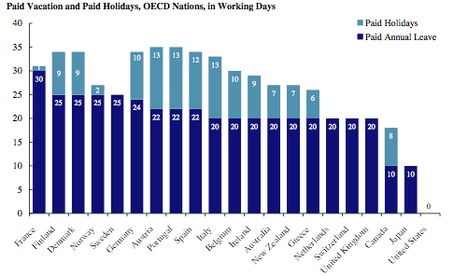
  • In every country included except Canada and Japan (and the U.S., which averages 13 days/per year), workers get at least 20 paid vacation days.  In France and Finland, they get 30 – an entire month off, paid, every year.
  • Then there’s this depressing graph on average paid vacation time in industrialized countries:
American paid vacations

The Impact of Too Much Work

I’m not telling you to work less hours. If you genuinely love what you do and are doing it for the right reasons, you are more than entitled to spend all of your waking hours plugging away.
But for many of us, more work leads to more stress and a lower quality of life. Without time to unwind, take care of your home, spend time with loved ones, enjoy our hobbies, connect with friends, and generally live a more balance life. Stress is the #1 cause of health problems – mentally and physically. And there are few things that stress us out on a consistent basis like work does, especially when it takes away from all of the other things that life has to offer.

Americans are the Outliers

And if all of this data tells anything, it’s that we are the outliers, not the norm. Why are we the outliers?
  • Our companies fairly ruthlessly let people go. We want to keep our jobs and not be a ‘low performer’ compared to others.
  • The decline of the union has led to less paid time off and other leave benefits.
  • Cultural value of money over everything else. We love money, we want more of it, and we think money can buy happiness. And the more we work, the more we get paid.
  • It’s been drilled in our heads that we are lazy compared to emerging market counterpart workers in India, Mexico, China, and other parts of Asia. Who isn’t? And what is our mental image of the work environments in those locales? To validate those fears, our jobs are being outsourced to the cheap labor in those countries. In reality, the U.S. is still the world leader in productivity per person.
  • Our legislative branch of the government (on both sides of the aisle) has been bought and as a result has shied away from passing laws that protect workers that every other industrialized nation has passed.
  • We generally don’t fight for our working rights. We take what is given to us.

What we All Need to Remember

What we all need to remind ourselves is that it doesn’t have to be this way.
  • It’s OK to ask to move to fewer hours at work.
  • It’s OK to take a week-long vacation if we need to.
  • It’s OK to ask to work from home.
  • It’s OK to take a month of unpaid leave while you raise a child.
  • It’s OK… you get the idea.
Don’t let life pass you by in the name of fear, circumstance, greed, or misguided hopes. Sometimes you just need to draw a line in the sand and say “enough is enough”.


Thursday, October 14, 2010

Justice: tilted toward the wealthy and moneyed interests

Access To Justice In U.S. At Third-World Levels, Says Survey
Scales Of Justice

Why haven't more Americans successfully sued the banks that lured them into fraudulent mortgages, then foreclosed on them without the required paperwork?

It could be because the civil justice system in this country is essentially inaccessible to many Americans -- and when it does get accessed, is tilted toward the wealthy and moneyed interests.

That's certainly consistent with the finding of a world-wide survey unveiled Thursday morning that ranks the United States lowest among 11 developed nations when it comes to providing access to justice to its citizens -- and lower than some third-world nations in some categories.

Particularly when it comes to access to and affordability of legal counsel in civil disputes, the U.S. ranks 20 out of the 35 nations surveyed, below not only developed nations but also such countries as Mexico, Croatia and the Dominican Republic.

The results are from the World Justice Project's new "Rule of Law Index", which assesses how laws are implemented and enforced in practice around the globe. Countries are rated on such factors as whether government officials are accountable, whether legal institutions protect fundamental rights, and how ordinary people fare in the system. The index will expand from 35 countries to 70 next year.

The lowest-ranking countries in this year's survey included Liberia, Kenya, Nigeria and Pakistan.

The U.S. didn't lead the world on any of the rule-of-law measures, ranking near the bottom of the developed world on most -- including even fundamental rights. But the most striking findings related to access to justice for ordinary people.

As part of its fact-finding, the organization polled 1,000 people in New York, Chicago and Los Angeles, and found a significant gap between the rich and the poor in terms of their use and satisfaction with the civil courts system. According to a news release:

For instance, only 40% of low-income respondents who used the court system in the past three years reported that the process was fair, compared to 71% of wealthy respondents. This 31% gap between poor and rich litigants in the USA is the widest among all developed countries sampled. In France this gap is only 5%, in South Korea it is 4% and in Spain it is nonexistent.

Juan Botero, the index's director, told the Huffington Post that the U.S.'s poor ranking on access to justice "is a little bit surprising" considering that our society is so prone to litigation, and so fascinated by TV shows about law and order. But he said the index simply quantifies what was already the consensus among legal experts: That when it comes to access to justice, "the U.S. could do a better job, especially with marginalized communities."

Indeed, the index's findings are consistent with previous studies of access to justice by lower-income people. The Legal Services Corporation reported last year that state-level studies had concluded that less than one in five of the legal problems experienced by low-income people are addressed with help from either a private or legal-aid lawyer.

Unequal access to the legal system is also a problem that the Obama administration has publicly acknowledged and is trying to address.

In March, Attorney General Eric Holder appointed prominent Harvard Law Professor Larry Tribe to serve as a senior counselor in charge of a new Access to Justice Initiative. His goal is to work with judges and lawyers across the country to find ways to help people who cannot afford a lawyer.

As Tribe himself put it in a June speech:

The truth is that as a nation, we face nothing short of a justice crisis. It is a crisis both acute and chronic, affecting not only the poor but the middle class. The situation we face is unconscionable. It's why the President and the Attorney General created the Access to Justice initiative that I am leading, and it's why we won't rest until we have made measurable and sustainable progress, but to make that progress and to do it across the board, we have got to first acknowledge that what we do know is far outweighed by what we don't know.

Botero said the index is not intended to be prescriptive. "The index doesn't give you a complete recipe for action; it doesn't even give you a full diagnosis. It's like a thermometer," he said.

Nevertheless, he noted that many other countries have more robust mechanisms to provide legal assistance to the poor.

For instance, in many Latin American countries, law students spend their final year of law school serving the poor. Or in Japan, many disputes are adjudicated by administrative bodies. In the U.S., he said, small claims court works very well. "However, the scope of coverage is limited." The result: "There seems to be a gap in the system."

The U.S. criminal justice system received a mixed grade in the new index, ranking well when it comes to guaranteeing due process of law, but ranking last among developed nations on delivering impartial justice.

How exactly does the index define access to justice? The report states:

In a nutshell, these factors measure whether regular citizens can peacefully and effectively resolve their personal grievances in accordance with generally accepted social norms, rather than resorting to violence or self-help.


For civil and informal justice, this implies a service that is affordable, effective, impartial, and culturally competent. For criminal justice, this implies a system capable of investigating and adjudicating criminal offences impartially and effectively, while ensuring that the rights of suspects and victims are protected.

Impartiality includes absence of arbitrary or irrational distinctions based on social or economic status, and other forms of bias, as well as decisions that are free of improper influence by public officials or private interests. Accessibility includes general awareness of available remedies, availability and affordability of legal advice and representation, and absence of excessive or unreasonable fees, procedural hurdles, and other barriers to access the formal dispute resolution systems. Access to justice also requires fair and effective enforcement of the decisions.

And why is all this important? The report explains:

Establishing the rule of law is fundamental to achieving communities of opportunity and equity--communities that offer sustainable economic development, accountable government, and respect for fundamental rights.


*************************
Dan Froomkin is senior Washington correspondent for the Huffington Post. You can send him an e-mail, bookmark his page; subscribe to RSS feed, follow him on Twitter, friend him on Facebook, and/or become a fan and get e-mail alerts when he writes.


Wednesday, October 13, 2010

The U.S. Chamber of Commerce’s foreign fundraising operation

Last week, ThinkProgress published an exclusive story about the U.S. Chamber of Commerce’s foreign fundraising operation. We noted the Chamber raises money from foreign-owned businesses for its 501(c)(6) entity, the same account that finances its unprecedented $75 million dollar partisan attack ad campaign. While the Chamber is notoriously secretive, the thrust of our story involved the disclosure of fundraising documents U.S. Chamber staffers had been distributing to solicit foreign (even state-owned) companies to donate directly to the Chamber’s 501(c)(6).
We documented three different ways the Chamber fundraises from foreign corporations: (1) An internal fundraising program called “Business Councils” used to solicit direct, largely foreign contributions to the Chamber, (2) Direct contributions from foreign multinationals like BP, Siemens, and Shell Oil, and (3) From the Chamber’s network of AmCham affiliates, which are foreign chambers of the Chamber composed of American and foreign companies. The Chamber quickly acknowledged that it receives direct, foreign money, but simply replied, “We are not obligated to discuss our internal procedures.” Instead of providing any documentation or proof to demonstrate foreign money is not being used for electioneering purposes, the Chamber launched an aggressive media strategy to first, attack ThinkProgress with petty name-calling and second, to confuse the media by highlighting the Chamber’s relatively minor AmCham fundraising, which the Chamber says (also without documentation) totals “approximately $100,000” from all 115 international AmCham chapters. The Chamber and the media largely ignored ThinkProgress’ revelation about the Chamber’s direct foreign fundraising to its 501(c)(6) used for attack ads.
Yesterday, the Chamber’s chief lobbyist Bruce Josten, who has been spoon-feeding much of the media distortions about our report, went on Fox News (whose parent company donated $1 million to the Chamber recently for its ad campaign) to again try to dilute the issue by dissembling about the Chamber’s fundraising and membership. “We have probably 60 or so foreign multi-national companies in our membership that we have had for decades, many of which have been in the United States for half a century or a century,” said Josten.
The Chamber is being deceptive. In addition to multinational members of the Chamber headquartered abroad (like BP, Shell Oil, and Siemens), a new ThinkProgress investigation has identified at least 83 other foreign companies that actively donate to the Chamber’s 501(c)(6). Below is a chart detailing the annual dues foreign corporations have indicated that they give directly to the Chamber (using information that is publicly available from the Business Council applications and the Chamber’s own websites):
Company Location Money/Level
4G Identity Solutions Hyderabad, India $7,500
A2Z Maintenance & Eng. Gurgaon, India $7,500
Amarchand Mangaldas Mumbai, India $15,000
Apollo Hospitals Chennai, India $7,500
Arshiya International Mumbai, India $15,000
Astonfield Management Mumbai, India $7,500
AXA Group Paris, France $7,500
Avantha Group India $7,500
Avasarala Technologies Bangalore, India $7,500
AZB & Partners Mumbai, India $15,000
Azure Power New Delhi, India $7,500
Bharat Forge Pune, India $15,000
Blake, Cassels & Graydon LLP Toronto, Canada $7,500
Brookfield Asset Management Toronto, Canada $7,500
Cameco Corporation Saskatoon, Canada $7,500
Credit Suisse Zürich, Switzerland $15,000
Devas Multimedia Bangalore, India $15,000
DSK Legal Bombay, India $7,500
Dua Associates Hyderabad, India $15,000
Educomp Solutions Ltd Delhi, India $7,500
Essar Group Mumbai, India $7,500
Fox Mandal Little India $7,500
GMR Bangalore, India $15,000
Hindalco Group, The Mumbai, India $15,000
Hinduja Group, The London, UK $15,000
Hindustan Construction Company Mumbai, India $15,000
HSBC London, UK $15,000
ICICI Bank Mumbia, India $7,500
Infosys Bangalore, India $15,000
Infotech Enterprises Hyderabad, India $7,500
International SOS Assistance Singapore $7,500
Ireo Management Gurgoan, India $15,000
ITC Group Kolkata, India $15,000
J. Sagar Associates Mumbai, India $15,000
J.B.Boda Insurance Mumbai, India $7,500
J.M. Baxi & Co. Mumbai, India $15,000
Jagran Prakashan Kanpur, India $7,500
Jindal Power New Delhi, India $15,000
Jubilant Organosys Noida, India $7,500
Kimaya Energy New Delhi, India $15,000
Kotak Mahindra Mumbai, India $7,500
KPIT Cummins Pune, India $7,500
KPMG Amstelveen, Netherlands $15,000
Lahmeyer International Frankfurt, Germany $7,500
Larsen & Toubro Mumbai, India $15,000
Leela Hotels Bengaluru, India $7,500
Linklaters LLP London, UK $7,500
Luthra & Luthra New Delhi, India $15,000
Macquarie Capital Sydney, Australia $15,000
Majmudar & Company Mumbai, India $7,500
NIIT Technologies Delhi, India $15,000
Nishith Desai Associates Mumbai, India $15,000
Novartis Basel, Switzerland $15,000
Oberoi Group Dehli,India $7,500
Patni Americas Mumbai, India $15,000
Punj Lloyd Gurgaon, India $15,000
QuEST Global Singapore $7,500
Ranbaxy, Inc. Gurgaon, India $7,500
Reliance Industries Mumbai, India $15,000
Reliance Communications Navi Mumbai, India $7,500
Rolta Mumbai, India $7,500
Sanofi-Aventis Paris, France $7,500
SKP Crossborder Consulting Mumbai, India $7,500
SNC Lavalin Montreal, Canada $7,500
State Bank of India Mumbai, India $15,000
Sun Life Financial Toronto, Canada $7,500
Tata Group Mumbai, India $15,000
Tatva Legal India $15,000
Urenco Investments Slough, UK $7,500
Trilegal India $7,500
Walchandnagar Industries Mumbai, India $7,500
Welspun Mumbai, India $7,500
Wipro Bangalore, India $15,000
TAIB Bank* Dubai $20,000
Aluminum Bahrain B.S.C Kingdom of Bahrain $10,000
Bahrain Financial Harbour Holding Company Kingdom of Bahrain $10,000
Gulf Air Kingdom of Bahrain $10,000
Midal Cables Kingdom of Bahrain $10,000
The Nass Group Kingdom of Bahrain $10,000
Bahrain Maritime & Mercantile International Kingdom of Bahrain $5,000
The Bahrain Petroleum Company Kingdom of Bahrain $5,000
First Leasing Bank Kingdom of Bahrain $5,000
Gulf Petrochemical Industries Company Kingdom of Bahrain $5,000
TOTAL   $885,000
Again, all of these annual dues are collected in the same 501(c)(6) the Chamber is using to run partisan attack ads. The data above reflects information from public sources, and the Chamber likely has many more foreign corporations as dues-paying members — but refuses to divulge any of the funders for their ad campaign. Unfortunately, many reporters in the traditional press covered the Chamber story, but missed the entire point of our reporting. Most reporters (from the New York Times, McClatchy, the Associated Press, etc.) never contacted ThinkProgress, instead opting to only interview Chamber officials.
Here’s how the Chamber’s unusual foreign fundraising operation works. According to this internal Chamber staff chart obtained by ThinkProgress, the Chamber has an international division devoted to promoting free trade and related policy issues. U.S. Chamber staffers, based here in Washington, D.C. with offices in the Chamber’s building at 1615 H Street, create bilateral “Business Councils” fundraising programs to solicit money from foreign corporations in Korea, Egypt, Brazil, Bahrain, India, and other places. For instance, the Chamber’s US-Egypt Business Council directs potential members to wire their checks to the US Chamber of Commerce. The application also notes that checks should be marked “ATTN: Leila Vossoughi.” Vossaoughi is a regular staffer at the Chamber. Promotions to join the Chamber have included promises that foreign firms obtain “access to the US Chamber of Commerce and everything that it does” and pledges to help the foreign firms promote free trade policies in America. All of the staffers who manage the Business Councils work directly for the Chamber. These Business Councils are nothing like the Chamber’s AmChams, which are foreign affiliates of the Chamber composed of American and foreign businesses abroad. Business Councils are based in the Chamber and even hosted on the U.S. Chamber’s website domain. Bylaws from the US-Bahrain Business Council confirm that the money the U.S. Chamber raises from these applications — which welcome foreign-owned businesses — goes into the Chamber’s 501(c)(6). Click below to see one such application:

application
Again, the information above documents the fact that foreign donations go directly to the Chamber without any intermediary, for instance, through an “AmCham” or another Chamber affiliate organization. The same Chamber account funded by these foreign corporation is running a $75 million attack campaign. In fact, a Chamber spokesperson acknowledged the foreign funds go into the Chamber’s general account. Any responsible reporter should have to note these direct donations given to the Chamber, which the Chamber has refused to discuss. Or, reporters should contact us directly if there is any confusion about our report.
ThinkProgress intern Riley Waggaman contributed to this post.